Free guide
A Renters Guide to Letting Agents
7 – 10 minutes to read
In this guide
Share this
1. Introduction
Most tenants rent their property via a letting agent. It is important to realise that
In most cases, the letting agent is not your landlord
The letting agent is someone, or an organisation, employed by your landlord to find a tenant for them and, sometimes, to manage the tenancy after the tenant has moved in.
However, they do not own the property and, under agency law, are not (save in a few exceptions) liable to you for any problems with the property. So, if you want to make a claim because your property is in poor repair, you will (in most cases) need to sue the landlord, not the letting agent.
A letting agent is employed by the landlord (a solicitor I know describes them as ‘the landlord’s bitch’ ) and have to do what the landlord says. Although they may appear sympathetic towards you, ultimatly their duty is to the landlord, their client, not you.
You also need to be aware that
Agents vary widely
There are good agents and there are bad agents. The good agents will probably have done training and will usually belong to a professional organisation such as ARLA Propertymark or RICS.
The bad agents may be ignorant of Landlord and Tenant law and some are actually criminal. So be careful who you rent from.
There is only limited regulation
Agents are supposed to belong to a Property Redress Scheme and carry client money insurance (more on this below).
However, there are no ‘entry requirements’ or qualifications needed to set up a letting agency (as there are for solicitors, for example). At the moment, anyway, although new rules are planned for the future. If you are faced with a criminal agency, it may be hard to enforce your rights.
Let’s take a look at some of these things in more detail. But first, let’s consider
2. Who is your landlord?
Sometimes tenants think that the agent is their landlord when they are not and sometimes the agent IS the landlord!
So how do you find out? The first thing to do is look at your tenancy agreement. Whose name is down as the landlord? If the agent is named, take a look at the signature at the end. Does it say next to the agent’s signature that they are signing as an agent?
If so, then that is an indication that they are acting as agent even though they have not told you who the real landlord is.
However, sometimes letting agents are the landlord, even if they do not own the freehold of the property (so they will not show up on a search of the Land Registry) because they have entered into a ‘rent to rent’ agreement with the property owner. This sort of agreement is where someone rents a property, not to live in, but to sublet to other tenants.
Rent-to-rent agreements sometimes have a bit of a bad reputation, and they have been used by dodgy letting agents and property investors (and also criminals). However, there are also some very reputable letting agents who run properly managed and ethical rent-to-rent schemes.
It is important to find out who your landlord is, as if there is any claim to be made, you have to sue your landlord, not the agent.
If it looks like the company named as landlord is actually an agent, you have the right to request them to disclose the identity of your true landlord under section 1 of the Landlord and Tenant Act 1985.
You can do this by making a written request (which can be by email) to the person or organisation you pay rent to.
For example, see the draft letter below:
Click on the button "copy text" to copy the text from the text field below. You can then paste this into a document of your choice. Amend the default text to show the agents name and address, the address of the property etc. Replace 'Yours etc' with however you normally end your letters or emails to the agents.
If the reply states that your landlord is a limited company, you can then request the name and address of every director and the company secretary under section 2 of the Act.
Incidentally, section 3 of the act requires anyone who purchases the property (and who then becomes your new landlord) to notify you of this within 2 months. Failure to do this is a criminal offence.
Although you may be better bringing a complaint to your agents Property Redress Scheme (see more on this below).
3. Agency Law
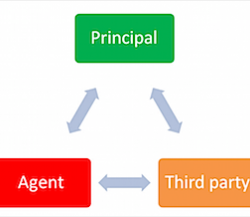
It is not often realised that there is a law of agency. It is a branch of contract law and deals with the situation where one person (the agent) is authorised to make a legal contract on behalf of another person (known as the principal) with a third party.
In landlord and tenant situations, the agent is the letting agent, the principal is the landlord and the third party is the tenant.
This isn’t the only kind of agency though. There are also shipping agents and agents who look after authors and actors. They are all governed by agency law.
The Agent’s client is not you
It’s important to realise that in a letting agent situation, the letting agent’s client is the landlord, not you. It is the landlord who is responsible for paying the agent’s commission (although in reality, it comes from the rent that you pay).
Managing agents are often given a lot of leeway by their landlords but when it comes down to it, it is the landlord who is the property owner and who is (or should be) in control of things.
As we say above, under agency law the agent is only liable to the landlord, not to you, so if you have any legal claim to make you sue the landlord, not the agent, even if it is the agent’s fault (although there is one exception, see below).
The Agent’s Authority
However also under agency law, an agent will have the authority (which is called ‘ostensible authority’) to bind the principal / landlord – even if it is against the landlords express instructions – so long as it is the sort of thing you would expect them to deal with.
If a letting agent gives you permission to keep a cat at the property, you can rely on this, even if the landlord has told the agent ‘no pets’. Because that is the sort of thing agents deal with. (It’s best to get permission in writing before you buy the cat!).
However, if you ask permission to knock down the back part of the house and rebuild it to a new design, this is not something agents usually deal with, so they will not have ‘ostensible authority’ to agree to this. So don’t spend money on alterations until you are sure the proper landlord has agreed. (It’s best not to spend a lot of money on someone else’s property anyway).
Secret Profits
Agents also have a duty to be honest with their principal and only charge fees which have specifically been agreed with them. If they make unauthorised charges then this belongs to the principal.
In the past letting agents often charged tenants fees that had not been agreed with the landlords and which the landlords were not aware of. Tenants were often outraged to learn that agents were legally supposed to pay these fees to the landlords and not back to them! This is why.
However, this problem does not arise now as most fees have been outlawed under the tenant fees rules (discussed here).
4. Current Letting Agent Regulation
Because there have been so many bad and indeed downright criminal letting agents, there is now some regulation of the industry.
Property Redress Schemes
All letting agents must now belong to one of the two government authorised property redress schemes which are:
If you are unhappy with the service provided by the letting agent managing your property or have a complaint about them, you can complain to their redress scheme. The schemes have the authority to order various things (such as an apology and up to £25,000 compensation).
You will need to have already raised the issue with the agent directly first though, and only if you are unable to resolve the problem directly should you apply to the redress scheme. You will find guidance on how to do this on the scheme websites (linked above).
If the agency is not a member of a redress scheme, then they are breaking the law and you can report them to the local Trading Standards Office.
Most agents comply with awards made by their redress schemes. However one of the weak points of the scheme as a whole is although the redress companies may make an award in your favour, if the agent fails to pay up, there is not a lot they can do to help you other than eject the rogue agent from their redress scheme.
If the agent is a rogue agent this may not bother them and they can pop up again, often from the same offices, operating under a different name and trading company.
It is to prevent this sort of thing from happening that most good agents support more stringent regulation of letting agents.
Voluntary Regulation
Many letting agents, keen to disassociate themselves from the rogue agents discussed above, will join a letting agent regulation organisation. The main organisations are
- ARLA Propertymark (Association of Residential Letting Agents)
- RICS (Royal Institution of Chartered Surveyors),
- Safeagent, or
- UKALA (the UK Association of Letting Agents)
If your letting agent is a member of one of these organisations you can probably (though not necessarily) trust them to be a responsible agent. These organisations also provide training for their members plus you will also have an additional avenue of complaint if your agent turns out to be unsatisfactory.
Insurance and Fees
These will not affect you so much but are included for completeness.
All agents are now required to
- sign up to a client money protection scheme and also
- to provide a list of all their fees on their website an in all their offices, along with
- Details of their Property Redress Scheme and
- Client money protection scheme
These rules are supposed to be enforced by Trading Standards offices and some are now starting to do this.
Agent Liability
As we said above, generally if there is something wrong with the property or your tenancy and you want to bring legal proceedings, you must sue the landlord not the agent.
However, a specific exception has been made for the tenancy deposit regulations. So if the deposit was paid to the agent, if they fail to protect it properly or serve the prescribed information on you, you can sue the agent for the penalty as well as the landlord.
You can find out more about the obligations relating to tenancy deposits in our article here.
5. Plans for the future
At the moment, although there is some regulation of letting agents, there are no regulations on who should be a letting agent.
Unlike, for example, the solicitor’s profession, to practice as a letting agent, you do not need to pass any letting agent exams or indeed have any qualifications at all. There are also no strict insurance obligations other than the requirement to carry client money insurance.
Many letting agents do have special qualifications but at the moment these are voluntary. However, a special working party report on the Regulation of Property Agents (nicknamed ROPA) was released by the Ministry of Housing, Communities and Local Government (MHCLG) in 2019 which recommended new licensing and regulation rules for letting agents.
These rules have yet to come into force and their implementation was delayed by the COVID pandemic. However, we are given to understand that the government is intending to act on the report in due course.
Exactly when this will be is anyone’s guess.
6. Tips for dealing with letting agents
So let’s finish with a few tips.
Before renting a property from an agent:
- Check whether they are a member of one of the voluntary regulation organisations referred to above, the most common being ARLA Propertymark (now known normally just as Propertymark).
- Check to make sure the agent is a member of a property redress scheme (you can normally find this out via the schemes’ website).
- If the letting agent promises to do anything, e.g. get some repair work done, before you move into a property – get this in writing.
- Never pay money in cash and always get a receipt.
- See if you can check them out online see below).
- If you are a student, if possible, keep to the agents and landlords recommended by your accommodation office.
Websites you can use to find or check agents:
- All agents has reviews of letting and estate agents in the UK.
- The National Trading Standards site has a property agent checker service
- If you are renting in London, you can check landlords and agents via the rogue landlord and agent database here.
- Google reviews, which you can find via Google Maps.
- Trustpilot.com
You should also check whether they belong to any of the following:
This is the end of this article.
Didn’t find your answer? Search again:
Search Articles
Would you like to speak to a solicitor about this?
A simple and straightforward way for you to get up to 1/2 hours telephone advice from a specialist landlord and tenant solicitor.